- What is a leisure battery?
- Essential leisure battery terminology
- What types of motorhome leisure batteries are available?
- What categories of motorhome leisure batteries are there?
- How to choose the best leisure battery for your motorhome
- Lead-Acid Leisure Batteries (Open & Sealed)
- AGM (Absorbent Glass Mat)
- Gel batteries
- Lead Crystal
- Lithium (LiFePO4)
- How to charge your motorhome leisure battery
- How to change a leisure battery on a motorhome
- Maintenance tips to look after your leisure battery
One of the best things about owning a motorhome is enjoying a domestic experience on the road. After all, just because you’re on holiday doesn’t mean you have to sacrifice the home comforts. But to enjoy these comforts, you need a leisure battery that’s totally separate from the one your vehicle operates from. The following blog will explore this exact subject, explaining the very best leisure battery for your motorhome.
As experts in our field of motorhome travel, at Spinney, we have all the knowledge and industry expertise to know leisure batteries inside out. Selling the very best new motorhomes, as well as quality used motorhomes offering the same manufacturing excellence at a fraction of the cost, at Spinney, we have everything you need to kick off your next motorhome adventure in style.
Knowing what the best leisure battery is for your motorhome is crucial to your experience on the road, with the wrong choice leading to insufficient power at the most inconvenient moment.
What is a leisure battery?
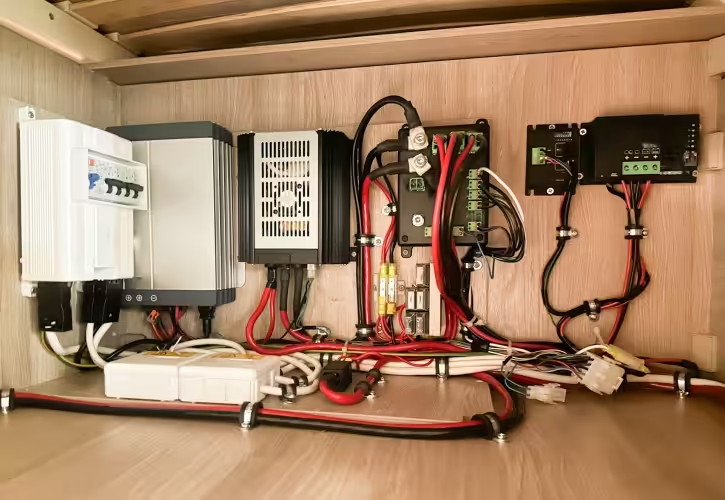
Let’s get the basics out of the way first and foremost. Ultimately, the leisure battery in your motorhome is what delivers power to essential appliances like the fridge and the oven, as well as non-essential luxuries like your TV and charging points. Crucially, a leisure battery is totally different from a car/motorhome battery that powers the vehicle, and they cannot be used interchangeably.
The majority of the motorhomes that we have for sale at Spinney come with a leisure battery included.
Essential leisure battery terminology
To better understand the types of leisure batteries on offer, it’s also essential to understand some terminology that is unique to this area of motorhomes. So, let’s clear a few things up:
- Discharge: Using the stored energy in a battery.
- Self-discharge rate: The rate at which a battery naturally loses charge while not connected to a load.
- Cycling: The act of discharging a battery before recharging it to its full capacity.
- Deep cycling: Discharging a battery until it’s below a charge level of around 50% before recharging.
Cycle life: The number of times a battery can be discharged and charged again before its overall capacity begins to drop to an inefficient level.
What types of motorhome leisure batteries are available?
Wondering ‘how long does a leisure battery last in a motorhome’? This depends on which one you opt for.
There are five key types of motorhome batteries available to consumers that each come with unique strengths and weaknesses. Exactly which one is the best for you will depend on what kind of holiday you‘re planning to have (more on that later). So, what are the main types of motorhome leisure batteries?
- Lead-Acid Leisure Batteries (Open & Sealed)
- AGM (Absorbent Glass Mat)
- Gel
- Lead Crystal
- Lithium (LiFePO4)
What categories of motorhome leisure batteries are there?
The National Caravan Council (NCC) Leisure Battery Verification Scheme breaks down leisure vehicle batteries into three different categories:
- Category A: Made for travellers who often go off-grid and need a motorhome battery that is used without electrical hook-ups. (minimum capacity 90 amp hour (Ah)).
- Including lithium and lead crystal batteries.
- Category B: Best for travellers who usually stay on sites with electrical hookups but need extra power for items like motor movers. (minimum capacity 90 Ah).
- Including AGM and gel batteries.
- Category C: These small batteries are great for those who plan to stay permanently on sites with electric hook-ups. (minimum capacity 60 Ah).
- Including both open and sealed lead-acid leisure batteries
How to choose the best leisure battery for your motorhome
Each type of leisure battery is built to be suitable for a particular type of travelling style, so picking the right one is crucial to the quality of your travels. If you’re wondering about the best leisure battery for your motorhome, explore our guide below.
1. Lead-Acid Leisure Batteries (Open & Sealed)
Lead-acid leisure batteries, both the open and sealed types, are two traditional forms of powering your motorhome, having been a popular solution ever since their introduction to the industry in the 1970s. But, these types are popular for a reason, working very efficiently while being affordable and easy to install and maintain. However, there are differences between the two.
Open lead-acid batteries
Otherwise known as flooded batteries, open lead-acid batteries work through a chemical reaction that takes place inside between a lead plate, liquid sulphuric acid and water. This type of battery requires constant maintenance since it has to be constantly topped up with an electrolyte to preserve its efficiency. Open lead-acid batteries are also particularly heavy, even if they cost a little less to purchase.
Sealed lead-acid (SLA/VRLA) batteries
Operating in the same way as open lead-acid batteries, the key difference with the sealed type is that no maintenance is necessary, with there being no topping up of electrolytes needed. This makes for an altogether cleaner and more efficient system that will last longer than the ‘open’ alternative. Just like an open battery, however, a sealed battery shouldn’t be discharged below 50% since this will cause irreparable damage to the cell.
Advantages: Widely available and fairly long-lasting.
Disadvantages: Require regular maintenance to keep up optimum performance.
Price: £50 – £150
Most suitable for: Travellers who will be spending the majority of their time in one campsite, hooked up to the electricity.

2. AGM (Absorbent Glass Mat)
These high-tech batteries work through the use of a fibreglass mat that’s tightly packed between two battery plates. These batteries are sealed and durable, meaning they can be stored on their side as well as the right way up. Efficient batteries ideal for general use, AGMs can be quickly charged and used below 50%, unlike lead-acid alternatives, and require no maintenance at all.
Advantages: Resistant to the vibrations of your motorhome, AGM batteries are safer and more durable than others on the market.
Disadvantages: Heavy and sensitive to being overcharged.
Price: Dependent on capacity – £70 – £250.
Most suitable for: Motorhome owners who enjoy roaming while on holiday and favour a reliable, robust battery.
3. Gel batteries
Just like AGM batteries, gel batteries are sealed but use gel electrolyte instead of a fibreglass mat to hold the battery acid in place. Performing well in hotter climates and on bumpy roads, gel batteries are ideal if you’re planning to tour around countries like France, where the temperature is high and your motorhome will experience plenty of vibrations while on the road.
Advantages: No maintenance needed, better suited to deep cycle applications and a lower self-discharge rate than aforementioned alternatives.
Disadvantages: Can be overcharged and are inefficient in cold weather conditions.
Price: Dependent on capacity – £90 – £500.
Most suitable for: Travellers who enjoy long excursions across the hot European climate.
4. Lead Crystal
Just like gel and AGM batteries, lead crystal batteries don’t require any maintenance, but are more advanced than these alternatives. A contemporary solution to leisure batteries, this type uses a crystalline lead-silicate compound in place of liquid acid or gel. Far more resilient than its counterparts, lead crystal batteries can withstand deep discharges and are fast to recover and quick to recharge.
Advantages: Resilient to high usage, lead crystal batteries are maintenance-free and can last for many years.
Disadvantages: Heavy and less commonly found in motorhomes.
Price: Expensive – £100 – £600+.
Most suitable for: Those who travel regularly off-grid and want a robust (if expensive) battery to rely on for the long term.
5. Lithium (LiFePO4)
Lithium batteries are on the very cutting edge of modern technology, becoming more common in the world thanks to their highly efficient, long-lasting nature. Known as LiFePO4 in the industry of motorhome leisure batteries, these lithium batteries last for an incredibly long time and can withstand high usage. Despite their optimum efficiency, they remain very expensive for general motorhome users.
Advantages: The future of electric motorhome travel, LiFePO4 batteries are lightweight, efficient and fast charging.
Disadvantages: Needs specific charging requirements.
Price: Very expensive – £200 – £600+.
Most suitable for: Serious motorhome users who are using their vehicle constantly and need a reliable source of electricity without the fuss of maintenance.
| Self-discharge rate | Cycle life | Maintenance needs | Price | Best for | |
| Lead-Acid Leisure Batteries | Moderately high | 200-350 | High | £50 – £150 | Low usage and regular electrical hook-ups. |
| AGM | Low | 200-400 | None | £70 – £250 | Motorhome owners who enjoy a moderate roam. |
| Gel | Low | 500-800 | None | £90 – £500 | Those who enjoy moderately long trips in hot climates. |
| Lead Crystal | Very low | Over 2,000 | None | £100 – £600+ | Off-grid travellers looking for a robust battery. |
| Lithium | Very low | Potentially over 5000 | None | £200 – £600+ | Frequent travellers who need reliable electricity. |
How to charge your motorhome leisure battery
Leisure batteries can be charged in a number of different ways, with the most efficient method being through the use of a split charger. A split charger uses the alternator to simultaneously charge the vehicle battery and the leisure battery. Crucially, while each of the five aforementioned battery types can be charged using this method, gel batteries and lithium batteries require extra care – generally, the use of a DC-DC charger is better recommended.
Alternatively, leisure batteries for your motorhome can be charged through the mains electricity of your home, provided you use the correct charger and smart chargers where necessary. These batteries can also be sufficiently charged on the go, particularly in sunny weather abroad, where solar panels and solar charge controllers can be used.
Want to find out more about how split chargers work?
How to change a leisure battery on a motorhome
Replacing the leisure battery in your motorhome is simpler than it may seem, requiring just a few steps. But if you would prefer a professional to do the job for you, our service team at Spinney would be more than happy to lend a hand.
- PPE: Before you begin, don’t forget to wear safety gloves and eye protection.
- Disconnect the battery: Disconnect the negative terminal first, followed by the positive terminal.
- Remove the battery: Carefully remove the battery from its fitting.
- Replace with the new battery: Connect the positive terminal first, followed by the negative terminal.
- Test the battery: Turn on applications around your motorhome to check to see if the battery is working. Properly recycle the old battery.
- Inform your insurance provider: To avoid any potential claim issues, it’s always a good idea to contact your insurance provider if you upgrade your leisure battery.
Maintenance tips to look after your leisure battery
Once you’ve got your new battery installed, it’s a good idea to keep in mind easy ways you can keep it maintained and in great working condition. These tips are not exhaustive and should be included as part of your regular maintenance checks.
- Keep the battery charged: Even when it’s not in use, make sure the battery is charged up to prevent it from becoming irreparably damaged. Using a multimeter is a great way to do this, but some motorhomes will have a display panel that will tell you how much charge is left. By avoiding deep cycles, you can prolong the life of the battery.
- Regular health checks: Regularly check the battery casing for cracks or leaks. This includes the gas breather pipe; if included, make sure this is tightly fitted at all times.
- Using the correct chargers and connectors: Make sure to always use the appropriate chargers and connectors on your battery; failing to do this can cause inefficiency and long-term damage.
- Properly maintain electrolyte levels: This applies only to open lead-acid batteries, whose electrolyte levels should be regularly checked and maintained above the minimum mark. PPE should be worn when monitoring this.
From maintenance tips from our team of experts to brand new leisure batteries for sale at our accessories shop, if you’re looking to upgrade the electrical system of your motorhome, at Spinney, we can help! But, if it’s not just your battery that could do with being replaced, why not browse our impressive selection of new motorhomes on sale, from the likes of Swift, Adria, Coachman, Bailey and more!
Electrify your motorhome experience with Spinney! Contact us today!

Written by Charlie Holland
- What is a leisure battery?
- Essential leisure battery terminology
- What types of motorhome leisure batteries are available?
- What categories of motorhome leisure batteries are there?
- How to choose the best leisure battery for your motorhome
- Lead-Acid Leisure Batteries (Open & Sealed)
- AGM (Absorbent Glass Mat)
- Gel batteries
- Lead Crystal
- Lithium (LiFePO4)
- How to charge your motorhome leisure battery
- How to change a leisure battery on a motorhome
- Maintenance tips to look after your leisure battery

Vogue
Exclusive Vogue - a special for everyone!
View our selection of Vogue special edition leisure vehicles available, only found here at Spinney.
Spinney branches
Spinney dealership