Taking your caravan into the great outdoors is one of the great freedoms of owning a leisure vehicle, and the lifestyle is simpler than you think to get into, but there are some essential things you need to know first. One of the most important things to get an understanding of is a caravan breakaway cable, a small piece of kit that might save you an enormous amount of money and stress.
As experts in the world of leisure vehicles with over 50 years of experience to our name, we have the knowledge to tell you all about breakaway cables and how they work. Stockists of the very best new caravans on the market, if you’re looking for an upgrade to experience the outdoors in an entirely new way, explore our range – you can even sell us your old vehicle for money off your new one!
But, before you explore our range, let’s get into absolutely everything you need to know about breakaway cables.
What is a Breakaway Cable?
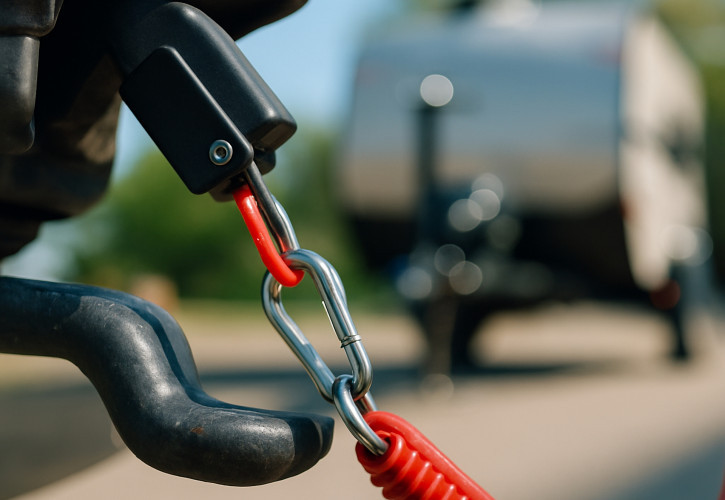
A breakaway cable is an essential safety feature that is designed to apply the brakes of the caravan if it becomes detached from the towing vehicle. Although small, breakaway cables are usually made from a thin, strong cable covered in a plastic coat that makes it sufficiently tough and durable for long-term use on the road. Checking the quality of your breakaway cable should be an essential part of your pre-driving inspection.
Why are Breakaway Cables Important?
Breakaway cables may seem inconsequential due to their size, but they are of vital importance, preventing the potentially severe consequences of a detachment while driving. While hitch failures are uncommon, using a breakaway cable gives you a buffer and a last line of protection if anything were to go wrong.
What’s more, it’s actually a legal requirement to use a breakaway cable or secondary coupling when driving in accordance with DVSA standards on caravan safety. Failure to properly comply with the regulations could result in a fine of up to £2,500, a ban on driving and 3 penalty points on your licence as a result of driving a vehicle in a dangerous condition. This doesn’t just apply to driving in the UK either, with countries across Europe, Australia and North America demanding the same level of due diligence.
How Does a Breakaway Cable Work?
Knowing how a breakaway cable works is a key part of knowing how to tow a caravan.
While essential, a breakaway cable is also a simple and efficient piece of kit. Designed to activate the caravan’s brakes if it becomes detached from the towing vehicle, to set the cable up, one end is attached to the caravan’s handbrake mechanism while the other is clipped to a fixed point on the tow vehicle. While the vehicle is being towed on the road, the cable will be slack enough not to apply the caravan’s brakes.
If disaster strikes and the caravan comes loose from the towing vehicle, the breakaway cable is pulled tight and disconnects or snaps. While it’s tigh,t it pulls on the brake lever of the caravan and brings the vehicle to a stop, helping to prevent a collision with an oncoming vehicle.
Different Types of Breakaway Cables
There is a small range of breakaway cables that can be used while you tow your caravan, with each one coming with its own advantages and disadvantages.
Snap clips
Snap clips, or spring clips, look a little like the hook of a dog lead with a small metal clip and a spring gate. They are generally considered the most basic form of breakaway cables. Thanks to their simplicity, they are quick and easy to detach and are also widely available if replacements are needed. However, they are a little more unreliable than alternatives and can weaken over time, becoming a safety liability in the process.
Carabiners
Different from snap clips in that they are more robust, offering a stronger spring gate or a locking mechanism, carabiner breakaway cables are very strong and are far less likely to unclip accidentally. Yet, they are more expensive to buy and are a little more fiddly to take on and off. With that being said, we’d recommend them if you wanted some peace of mind while taking your caravan on the road.
Coiled Breakaway Cables
Generally, more popular across the pond in the USA, thanks to the sheer size of their trailers, coiled breakaway cables stretch more when pulled to prevent the cable from dragging. Preventing unintentional tangling or dragging, coiled breakaway cables can, however, lose tension over time and thus lose their most positive features.
How to Attach a Caravan Breakaway Cable
It’s important that you attach a breakaway cable properly, but thankfully for caravan owners, the process is straightforward. You can easily attach the breakaway cable without the need for tools, but you may find the following implements useful:
- A screwdriver. This can be useful when prying open the strong attachment ring of the cable.
- Pliers. To help to efficiently close the ring.
- A hacksaw. If you need to remove the old attachment ring still attached to the caravan.
While the installation of a breakaway cable may vary slightly depending on the type of cable or whether you’re using a new or used caravan, the general method of attachment is as follows:
Attaching the Cable to the Caravan
- Find the Designated Caravan Brake Point: Locate the caravan’s brake lever – there should be a designated hole underneath where the breakaway cable can be attached.
- Secure the Cable to the Brake Point: Once located, use a screwdriver to help pry open the ring end of the breakaway cable (if necessary) and attach to the brake lever hole.
- Test the Connection: Manually pull on the cable to make sure that it activates the caravan’s brakes and works as intended.
Attaching the Cable to the Towing Vehicle
- Find the Designated Attachment Point: Some vehicles will have a towing eye that is perfect for attachment with a carabiner. If there are no visible holes or loops, loop the cable under the coupling head and around the neck of the towbar before clipping it back onto itself.
- Secure the Cable to the Attachment Point: Attach the cable by using the spring gate of the cable head. Ensure the clip has fully closed around the loop and is secure.
- Final Checks: Make sure the cable has a little bit of slack when it’s hitched but not too much that it drags. Firmly pull on the cable to make sure it’s efficiently secured.
How to Maintain Your Breakaway Cable
The breakaway cable between your caravan and towing vehicle is one of the most important things to check before you set off on any trip. Alongside knowing how to safely hitch your caravan, being aware of how to properly maintain a breakaway cable could save you considerable amounts of money and even a potential legal headache. A breakaway cable should be replaced if any of the following issues are found:
- Frayed wiring or splitting outer casing
- Rust, corrosion or discolouration of the cable
- Damage to the clip or carabiner (such as a stiff or weak clip gate, or a deformed clip)
- Kinks in the cable
Breakaway cables are made to break away (hence the name), but if you ever get into a situation where the cable has to be activated, it should always be replaced afterwards. This is because a used cable may be stretched and the clip may be bent out of shape, causing it to become ineffective.
Checking a Breakaway Cable Before a Journey
You should check for the aforementioned issues before every journey you take with your caravan. In addition, the DVSA also recommends that before you set off, you ensure that:
- There is enough slack in the breakaway cable so that the brakes on the caravan aren’t mistakenly activated.
- The cable does not drag across the ground while you’re driving.
The Breakaway Cable and the Hitching Process
To finish off, let’s put the use of the breakaway cable in the context of the hitching process, going through the procedure step by step to further outline essential things to remember. Hitching a caravan is the main thing new caravan customers feel intimidated about, but once you’ve done it once, you’ll find it a complete doddle.
- Check the Caravan Interior: Understanding the dimensions and weight of a caravan is essential for every owner to ensure that the vehicle is within the legal payload limit. You should also make sure that all windows and doors are firmly closed.
- Examine the Caravan’s Tyres: Check the tyres of your caravan for cracks or bulges and make sure the tyre pressure is accurate using a pressure gauge.
- Positioning the Towbar: Apply the brake of the caravan and wind down the jockey wheel so the coupling head is higher than the car’s towball. Give yourself plenty of height clearance.
- Start Reversing: It’s worth noting that this step is far easier with a helping hand, so grab a loved one or a kind neighbour. Slowly reverse your towing vehicle into a position just under the caravan’s tow hitch.
- Lower the Caravan Hitch: Slowly lower the hitch into the tow ball using the jockey wheel and carefully secure it with the stabiliser.
- Attach Your Electrics: Plug in the electrical cabling when sockets are dry and when the car’s ignition is switched off. Now’s the time to connect your breakaway cable, too. Allow for some slack in the cabling.
- Check Your Lights: Operate all the tail lights and indicators and ask your handy helper to tell you whether any of them are operating incorrectly. Any broken bulbs should be immediately replaced.
- Attach the Number Plate: If not already attached, you can fit a number plate with sticky back pads or specialised brackets.
- Conduct Final Checks: Set your towing mirrors so that you can see an equal amount of caravan on either side. Next, make sure the corner steadies of the caravan are raised, and the winder, levelling ramps and wheel chocks are packed away.
Mechanisms not quite working as they should? Think your caravan is in need of an upgrade? At Spinney, we sell a range of quality caravans from the very best brands in the industry, including the likes of Swift, Bailey and Coachman. But, aside from stocking the best caravan makes on the market, we can also help you to prepare your vehicle for its next adventure, with our servicing packages allowing you to travel with the utmost confidence.
Ready for an upgrade? Contact us today to find the very best new and used caravans for sale!

Written by Charlie Holland

Vogue
Exclusive Vogue - a special for everyone!
View our selection of Vogue special edition leisure vehicles available, only found here at Spinney.
Spinney branches
Spinney dealership